
What Hermeticism Actually Is
Beyond “As Above, So Below”

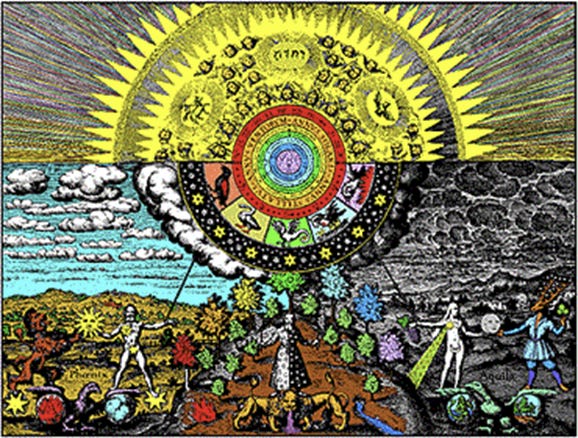
Hermeticism is often reduced to a phrase, an aesthetic, or a loose collection of occult ideas. In popular use, it appears as shorthand for secrecy, mysticism, or the famous maxim “as above, so below.” The New Age movement absorbed many Hermetic ideas as well, often turning demanding spiritual principles into easy shortcuts, sugarcoating inner work, and surrounding them with an atmosphere of toxic positivity. While these associations are not entirely misplaced, they do not go very far.
At its core, Hermeticism is not simply a set of mysterious teachings. It is a philosophical and spiritual vision of reality. It presents the cosmos as living, ordered, and intelligible, and it understands the human being as capable of participating consciously in that order. In this view, knowledge is not merely the accumulation of information; it is a form of inner alignment with the deeper structure of the world.
To understand Hermeticism in this fuller sense is to move beyond slogans, lists, and atmospheres into a tradition that has shaped Western esotericism for centuries. It is also to recover a way of seeing that remains strikingly relevant in a fragmented age: a way of reading the world as meaningful, relational, and alive.
A Living Cosmos
At the heart of Hermetic thought is the conviction that reality is ordered at every level. The cosmos is not a heap of disconnected material events, nor is the human being an accidental observer standing outside it. The world is structured, alive with meaning, and bound together through relationships that can be perceived, contemplated, and, to some extent, participated in consciously. Hermetic philosophy therefore begins from the premise that human consciousness is not alien to the cosmos, but belongs within the larger order it seeks to understand.
This vision of reality stands at some distance from the assumptions of modern thought. The Hermetic cosmos is not a dead mechanism composed of inert matter alone. It is an intelligible whole, one in which visible and invisible dimensions of existence are related rather than radically severed. To speak of a living cosmos, in this context, is not to indulge fantasy, but to affirm that reality is meaningful before it is useful, and that the world may be contemplated as well as measured.
The Human Being as Microcosm
In alchemy, people often quote the principle of correspondence as “as above, so below, as below, so above.” Yet this familiar phrase is a modern shorthand, not the way the line is usually rendered in translations of the Emerald Tablet. In Dennis William Hauck’s translation, the text reads: “That which is Below corresponds to that which is Above, and that which is Above corresponds to that which is Below, to accomplish the miracle of the One Thing.”¹ This specific phrasing shows that above and below are meant to be brought into relation, not treated as separate or opposed realms. Its phrasing is precise and practical. It does not invite us to bypass the world below in favor of some imagined spiritual altitude. It describes a process through which above and below must be brought into conscious relation.
The Emerald Tablet, traditionally attributed to Hermes Trismegistus, survives through a long textual tradition rather than as a recovered original artifact. That makes the exact wording of the line historically complex, but the central idea remains consistent: above and below correspond because reality is ordered across levels. The point is not that the material world is disposable and the spiritual world is real. Rather, the point is that the two reflect one another and must be understood together.
This is where the Hermetic understanding of the human being becomes so important. We begin below because that is where we live. We begin in embodied life, in matter, in limitation, in practice, in the unfinished conditions of ordinary existence. To imagine that one can leap immediately into the highest spiritual realities without first doing the work of integration is not enlightenment but inflation. Hermetic thought does not teach contempt for the lower world. It teaches the disciplined union of lower and higher, body and spirit, earth and heaven.
The human being, in this sense, is a microcosm: a little world reflecting the greater world. To know oneself is therefore not separate from knowing the cosmos, because the same intelligible order that shapes the whole is also present in the part. The work is not to escape the below, but to refine it so that it can participate more fully in the above. When we value only what seems lofty, abstract, or spiritual, and dismiss the embodied world as inferior, we fracture the very relationship Hermeticism asks us to heal.
Knowledge as Transformation
Hermeticism understands knowledge differently than the modern world usually does. In modern terms, knowledge is often treated as the accumulation of information: facts gathered, organized, and stored. In the Hermetic tradition, however, knowledge is not merely descriptive. It is transformative. To know reality truly is to become inwardly capable of receiving it.
As the Corpus Hermeticum states, “If then you do not make yourself equal to God, you cannot apprehend God; for like is known by like.”² The point is not that the human being becomes identical with the divine in some crude sense, but that true apprehension requires likeness of being. One comes to know higher realities by becoming capable of them. Knowledge, in this framework, is not simply the collection of facts about reality. It is the refinement of the knower into greater likeness with what is known.
The text sharpens the contrast a few lines later: “But if you shut up your soul in your body, and abase yourself, and say ‘I know nothing, I can do nothing; I am afraid of earth and sea, I cannot mount to heaven; I know not what I was, nor what I shall be,’ then what have you to do with God?”³ Hermetic philosophy therefore refuses the split between knowledge and being. What one is able to know depends, in part, on what one has become.
The soul narrowed by fear, vanity, distraction, and appetites remains confined to the surface of things. The soul disciplined through contemplation, ethical formation, and symbolic understanding becomes capable of perceiving deeper realities. Knowledge is not only something one possesses. It is something one grows into.
How Hermetic Knowledge Is Gained
If Hermeticism understands knowing as transformative, then it cannot be approached in the same way one acquires ordinary information. It is not simply a matter of collecting doctrines, memorizing correspondences, or repeating spiritual slogans. Hermetic texts suggest that higher understanding requires an inward reordering of the knower. One does not stand outside reality and master it from a distance. One comes to know by entering into deeper conscious relation with the order one seeks to understand.
This process begins in reflection, but not in reflection alone. It begins in the disciplined practice of turning inward, examining the soul, and learning to perceive the relation between the human being, the cosmos, and the divine. Hermetic knowledge is cultivated through contemplation, self-study, ethical refinement, and sustained attention to the patterns that link inner and outer life. The practitioner learns not only to think about reality, but to become more inwardly proportionate to it.
This is why Hermeticism is inseparable from what alchemical tradition later calls the Great Work. The Great Work is not only the transformation of substances, but the transformation of the self. It is the long labor through which one learns to know oneself, not as an isolated ego, but as a participant in the greater order of cosmos and God. In this sense, self-knowledge is not the end of the path. It is the doorway through which the human being comes to understand both the structure of the world and the source from which that structure proceeds.
The task, then, is neither self-absorption nor escape from the world. It is integration. Through reflection, contemplation, symbolic study, and disciplined practice, the scattered elements of the soul are gradually brought into relation with one another and with the greater whole they reflect. Hermetic knowledge is gained through this work of alignment. It is not a shortcut, and it does not bypass the difficulties of embodiment. It asks for patience, seriousness, and the willingness to be changed by what one seeks to know.
Why Hermeticism Still Matters
In a disenchanted age, Hermeticism offers a different account of meaning. It reminds us that the world is not mute, and that human consciousness is not separate from the deeper order it seeks to understand.
Modern life often trains us to imagine reality as fundamentally mute: matter without meaning, consciousness without context, and knowledge without transformation. The world becomes a field of objects to be measured, used, and managed, but no longer contemplated. Under such conditions, symbols appear decorative, ritual appears irrational, and self-knowledge collapses into private introspection. We may know more and more about the mechanisms of things while understanding less and less about how to situate ourselves within the whole.
Hermeticism speaks into that fragmentation by refusing the sharp divisions that define so much modern thought. It does not separate matter from spirit, self from cosmos, or knowledge from being. Instead, it presents reality as ordered, relational, and alive with intelligibility. This does not mean that every event carries a simplistic message, nor that the world exists merely to mirror our desires back to us. It means that human beings inhabit a cosmos whose structure can be contemplated, participated in, and, to some extent, known.
Disenchantment has not made modern people less hungry for meaning; it has simply left many searching for it in forms too thin to bear the weight. Some turn to reductionism and learn to expect nothing from the world but mechanism and accident. Others flee into sentiment, vague spirituality, or fantasies of instant transcendence. Hermeticism offers a more demanding path than either of these. It does not ask for the denial of reason or for the abandonment of the material world. It asks, instead, for disciplined perception: the patient work of learning to read the relations between self, world, and the divine.
In this sense, Hermeticism remains relevant not because it flatters modern spiritual tastes, but because it challenges some of modernity’s deepest distortions. It opposes the idea that knowledge is only data, that the self is sealed off from the cosmos, and that matter is empty of significance. It insists that wisdom requires transformation, that symbols disclose pattern, and that the human being is capable of more than passive observation. To recover this way of seeing is not to retreat from the contemporary world, but to re-enter it with greater depth, seriousness, and proportion.
Hermeticism still matters because it offers a way beyond both nihilism and fantasy. It teaches that meaning is neither projected onto a blank universe nor handed to us through easy consolation. Meaning emerges through relation, contemplation, and participation in a world that is more than inert substance. In reminding us of this, Hermeticism does not solve the modern crisis of fragmentation all at once. It does, however, offer a way to begin reading the world again as meaningful, relational, and alive. To study Hermeticism, then, is not merely to recover an old philosophy. It is to practice a different relation to reality itself.
1 Dennis William Hauck, The Emerald Tablet: Alchemy for Personal Transformation (New York: Penguin Compass, 1999).
2 Corpus Hermeticum XI, in G.R.S. Mead, trans., Thrice-Greatest Hermes (Renaissance Classics, 2012), 71.
3 Corpus Hermeticum XI, in Mead, Thrice-Greatest Hermes, 71.
If this reflection resonated with you, consider subscribing to The Living Flame. New essays arrive twice a week exploring the symbolic languages of the Western esoteric tradition.