
When Venus Calls
A personal encounter with Venus, self-worth, and symbolic practice

In the previous essay I wrote about Venus as the principle of valuation itself—the faculty through which worth is recognized before it is justified. The reflection below is the moment I first felt that principle moving in my own life.
When I first began experimenting with planetary ritual several years ago, I thought the work would be technical. I imagined learning correspondences, planetary hours, and ritual structures. What I did not expect was that a symbol would begin speaking back.
The story that follows unfolded during a period of financial uncertainty and vocational exhaustion. At the time, I understood it simply as a strange and meaningful personal experience. Only later, after studying astrology more deeply, did I realize that something more symbolic had been taking place.
Venus was not asking for devotion.
She was asking me to recognize value.
The Voice in the Basement Office
Choose me.
The voice seemed to echo through the dim cocoon of my basement office. The only light came from the pale glow of my computer screen.
Choose me.
I can show you everything.
I swiveled slowly in my chair, half amused with myself, half waiting for the feeling to pass. I needed to choose a planetary deity to work with for a course I was taking on planetary magic. A simple enough task, at least in theory. The traditional seven planetary powers sat before me like options on a celestial menu: the Sun, the Moon, Mercury, Venus, Mars, Jupiter, and Saturn.
Naturally, I leaned first toward the Moon. Who would not want to work with a mysterious goddess of tides, dreams, and cycles? She seemed well suited to help me uncover whatever unseen forces were blocking my financial stability.
Mercury tempted me as well—the quicksilver patron of writing, communication, and clever solutions. Jupiter beckoned with promises of expansion and abundance.
But the voice returned.
You should choose me. I can help you the most.
Venus.
Immediately I resisted the idea.
Why Venus?
Venus? Really?
What could the goddess of love, beauty, and aesthetic delight possibly offer someone in my situation—a frazzled adjunct professor staring down financial anxiety and professional uncertainty?
I shut off my computer and went upstairs, trying to dismiss the thought entirely. My imagination had clearly been working overtime. Still, the question lingered.
Why Venus?
At the time, my life felt precarious. I was teaching two online humanities courses, barely enough to cover expenses, and one of those contracts was about to end. Adjunct teaching had never been stable work, but enrollment declines had made it even more uncertain.
A few years earlier, I left a toxic job that had drained me completely. Since then, I had been surviving on a fragile combination of savings and temporary teaching contracts. I sent out applications and occasionally landed interviews, but nothing solid materialized.
The truth was complicated. I needed a job desperately, but I also felt no real desire for any of the positions I was applying for. My previous experiences in higher education had left me feeling disposable and exploited. Administrative work felt lifeless to me. Yet survival demanded that I keep trying.
Fear has a way of narrowing the imagination. In that moment, it narrowed mine to a single anxious question: how would I keep the lights on?
When Venus Calls
Later that evening, while brushing my teeth—a strangely reliable setting for moments of clarity—my mind wandered unexpectedly back into memory.
A television show from my youth appeared in my mind: a young Johnny Depp, delicate and androgynous, radiating a kind of fragile beauty that had fascinated me when I was younger. The memory triggered a cascade. One after another, childhood crushes surfaced in my mind: actors and musicians whose beauty shared the same ambiguous, fluid quality.
I began laughing. Then laughing harder.
Something suddenly became obvious that I had never fully articulated to myself before.
For most of my adult life I had identified as bisexual, but the deeper pattern had always been there. I had consistently gravitated toward feminine energy in its many forms. Looking back, the signs were everywhere. As a child my stuffed animals were all girls. I often missed when women flirted with me. Growing up Catholic had quietly pressed me toward a heteronormative path that never quite fit, yet I followed it anyway because it seemed like the only available option.
Even after acknowledging my orientation later in life, parts of the story had remained buried.
Standing there under the bathroom light, the realization unfolded with startling clarity. I had been overlooking something essential about myself for years.
Tears came suddenly—not from sadness, but from a strange sense of relief. Something inside me had shifted. A hidden piece of the pattern had finally come into view.
In retrospect, I can see how perfectly this moment reflected Venus’s domain. In the modern imagination Venus is often reduced to romance or aesthetic pleasure. But within the older symbolic traditions, Venus represents something deeper: the faculty through which value is perceived. When that faculty becomes distorted—through exhaustion, fear, or cultural pressure to justify our existence through output—we lose the ability to perceive worth in ourselves.
That evening, Venus restored that perception.
The insight did not stop with sexuality. Another recognition followed closely behind it.
I had spent much of my life struggling to understand why I moved through the world differently than many people around me. Social environments often felt overwhelming or opaque. Certain structures that seemed natural to others felt draining or incomprehensible to me.
Only later would I understand that I am autistic with ADHD (AuDHD).
At the time, however, the realization arrived in a simpler form: the things I had spent years treating as flaws were actually part of the way my mind worked. They were not signs of deficiency, they were differences in perception.
And those differences carried their own forms of insight.
Choosing the Symbol
By the time I returned downstairs that night, the choice felt clear.
I chose Venus.
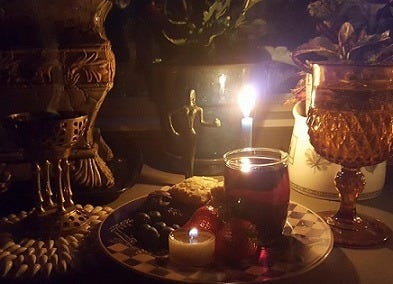
My ritual tools were simple: a few small crystal charms, candles, a glass of wine, some berries, and a pink stuffed bunny placed on a makeshift altar. All things I had around the house. The setup would probably make a formal ceremonial magician laugh, but sincerity matters more than theatrical perfection in these things.
Then something unexpected happened.
When Worth Changes First
Only a few weeks later, I received an email offering me an interview for a job I had never applied for. The opportunity appeared seemingly out of nowhere.
The interview process itself, however, still required the ordinary work of proving competence. There were call-backs, additional conversations, and the quiet tension of waiting for decisions. Nothing about that part was automatic.
What had changed was something inside me.
For the first time in years, I was not approaching the process from a place of desperation or self-doubt. The realization that had unfolded that night—the recognition that worth precedes performance—shifted the way I showed up. I spoke more clearly. I trusted my experience. I answered questions without the quiet apology that had often accompanied my work before.
In short, I interviewed as someone who already possessed value.
The position was not in my academic field, but it provided stable income during the uncertain months that followed and ultimately carried me through the upheaval of the pandemic.
At the time I considered the timing a curious coincidence.
Years later, while studying astrology more seriously, another layer of the story revealed itself. Venus rules my natal chart. She sits in my first house—in Taurus, her own sign—closely tied to the themes of identity, embodiment, and self-worth.
Of course she had called.
Of course I had resisted.
Symbols often enter our lives in this way—not as abstract ideas, but as encounters that reorganize perception. Only later do we recognize the pattern that was already present.
Looking back now, I know Venus wasn’t asking for devotion that night.
She was asking a quieter question.
What in your life is already worthy of love?
And once I understood that, the rest of the story unfolded.
Sometimes our work with a symbol begins this way—not through doctrine or technique, but through a moment of recognition that quietly rearranges the way we see ourselves.
Learning to recognize those moments is where symbolic practice—and a real conversation with the symbols—truly begins.
In future essays we will explore how the Venus principle can be cultivated intentionally through symbolic practice.
If this reflection resonated with you, consider subscribing to The Living Flame. New essays arrive twice a week exploring the symbolic languages of the Western esoteric tradition.