
How to Read a Symbol
Understanding Archetypal Patterns in Myth, Tarot, and Astrology

How to Read a Symbol
Modern readers often approach symbols as if they were coded messages. In this view, the task is simply to look up what a symbol means and apply that definition. There is nothing wrong with this approach for those newly introduced to symbolic traditions, yet it limits the range of how symbols actually operate.
The historian of religion, Mircea Eliade, observed that symbols disclose dimensions of reality that cannot be communicated through ordinary language alone.[i] Symbols do not merely decorate ideas; they reveal patterns of meaning that cannot be fully expressed in literal language.
Symbolic traditions therefore function on a deeper level. A symbol is not a code to be deciphered but a pattern to be recognized. Once that pattern becomes visible, a new level of understanding opens that allows us to perceive the same structure appearing across many different symbols.
What makes a symbol readable is therefore not a fixed definition but the archetypal pattern it expresses. When that pattern becomes visible, the symbol begins to speak, revealing a much older structure of thought preserved within the symbolic traditions of myth, astrology, and tarot.
Archetypes: The Patterns Beneath Symbols
An archetype is a recurring pattern of human experience that appears across cultures, myths, and symbolic systems. These patterns describe structural movements within life itself: the hero’s journey, the emergence of new life and new ideas, cosmic creation stories, descent and return, crisis and transformation, death and renewal, and the moment of revelation that follows uncertainty.
Archetypes should not be confused with stereotypes. A stereotype reduces people to simplified categories, while an archetype describes patterns of experience that many individuals encounter at different moments in life.
Greek philosopher Plato suggested that the visible world itself reflects deeper patterns. In Timaeus, he writes that the cosmos was fashioned “in the likeness of an eternal model.”[ii] Several centuries later, the Neoplatonic philosopher Plotinus expanded this idea, arguing that the forms we encounter in the visible world originate in a deeper intelligible reality.[iii]
Symbolic traditions give visible form to these deeper patterns through images, myths, and systems such as astrology and tarot.
The same archetypal movement can appear through many different symbolic images. If we follow the archetype of crisis and transformation, we find it appearing across multiple traditions.
In myth, it may appear as Persephone descending into the underworld.
In astrology, it may appear through the sign of Scorpio.
In Tarot, it may appear through cards such as Death or the Tower.
The imagery changes. The pattern remains.
Why Symbols Repeat Across Traditions
Mythology, astrology, and tarot developed in different historical contexts, yet they repeatedly portray the same movements of human experience. This repetition is not accidental. It reflects the archetypal patterns that structure psychological and spiritual life.
Archetypes persist because they arise from the recurring structures of human experience itself.
Symbolic traditions portray these transitions through images that make the underlying pattern visible. The myth of Persephone, for example, tells the story of a descent into the underworld followed by a transformation of Persephone’s identity from girl to queen, and a return to the light that restores life to the earth. Astrology expresses a similar pattern through the symbolism of Scorpio, a sign long associated with death, transformation, and regeneration. Tarot presents the same movement through cards such as Death or the Tower, which depict the collapse of an old structure so that a new reality can emerge.
Although the imagery differs, the structure of the experience remains recognizable. Each system portrays the same movement: a descent into crisis, the dissolution of what once seemed stable, and the possibility of renewal that follows.
In my previous essay, When Venus Calls, I described an experience that followed this same pattern. My encounter with the symbol of Venus altered my understanding of value so profoundly that I began to see myself differently. What had once seemed fixed about my identity and worth dissolved, and something new began to emerge in its place. Only later, when I looked back on the experience, could I recognize the pattern that had unfolded: crisis, dissolution, and renewal.
Experiences such as this are one way archetypal patterns become visible in one’s life.
Symbolic traditions preserve these patterns in images and stories so that we can recognize them when they appear in our own lives.
When multiple symbolic traditions portray the same pattern, they are not copying one another. Each observes the same underlying reality through its own symbolic language.
How Archetypal Patterns Appear in Symbols
Once we recognize that symbols express archetypal patterns, the next step is learning how to perceive those patterns within a specific image. This process does not require memorizing fixed meanings. Instead, it involves asking a series of interpretive questions that reveal the movement taking place within the symbol.
The first question asks what pattern is unfolding. Many symbols express familiar archetypal movements such as transformation, conflict, revelation, or integration mentioned in the previous section. Identifying the pattern allows the symbol to be understood as part of a larger structure rather than as an isolated image.
The second question asks what stage of the pattern the symbol represents. Once the underlying pattern—whether transformation, conflict, revelation, or integration—has been identified, the next step is to determine where the symbol falls within its unfolding movement. Archetypal patterns typically progress through recognizable phases: a beginning that establishes the situation, a crisis that disrupts it, a transition in which the old structure dissolves, and a resolution in which a new form begins to emerge. A symbol often captures a single moment within this larger movement.
The third question asks how the symbol gives visible form to the pattern. Symbolic traditions express archetypal movements through images drawn from nature and human experience: lightning that shatters a structure, descent into darkness, the appearance of light, the movement of water, or the call to judgement.
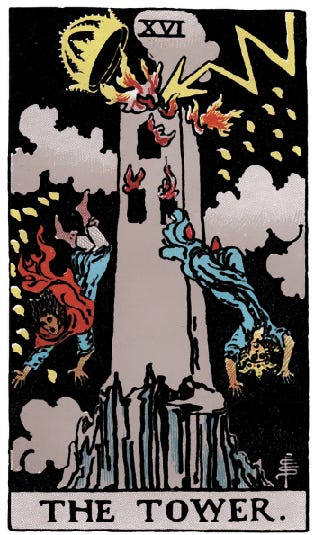
The Tarot card known as the Tower provides a clear example. The image depicts a lightning strike that shatters an established structure. The archetypal pattern behind the image is sudden revelation: the moment when reality interrupts illusion and forces a reordering of what once seemed stable.
By recognizing the pattern, the stage, and the symbolic form, the meaning of the image begins to emerge naturally.
Symbols Often Appear in Sequences
Archetypal patterns rarely appear as isolated moments. Most symbolic traditions present them as sequences that unfold over time. A single image may capture one stage of a transformation, but a sequence of symbols reveals the full movement of the pattern from beginning to completion.
Mythological narratives provide one of the clearest examples of this structure. Stories often follow a recognizable progression in which an ordinary situation is disrupted, a descent into crisis occurs, and a transformation eventually leads to renewal or revelation. The individual events within the story are meaningful on their own, yet their deeper significance becomes clear only when they are understood as stages within a larger pattern.
Many symbolic systems organize their images in a similar way. Instead of presenting isolated symbols, they arrange them into sequences that portray the unfolding of an archetypal process. Each symbol represents a moment within the larger movement, allowing the observer to trace the development of the pattern step by step.
The Tarot provides one of the most striking examples of this symbolic structure. Within the sequence of the Major Arcana, certain groups of cards portray a recognizable movement from illusion and disruption toward clarity and integration.
In the next essay, we will explore one such sequence in detail, tracing how the symbols unfold across the final arc of the Major Arcana:
The Devil → The Tower → The Star → The Moon → The Sun → Judgement
Read individually, each card carries its own symbolic meaning. Read as a sequence, they reveal a powerful archetypal pattern that moves from entrapment and collapse toward illumination and awakening.
Symbols do not merely describe the world; they help us perceive patterns that might otherwise remain unseen Once those patterns become visible, the images preserved in myth, astrology, and tarot begin to form a language through which human experience itself can be understood.
Citations
[i] Mircea Eliade. Images and Symbols (1961), Princeton University Press edition, 12–13.
[ii] Plato. Timaeus 29a
[iii] Plotinous. Ennead V.8.7–9, “On the Intellectual Beauty”.
If this reflection resonated with you, consider subscribing to The Living Flame. New essays arrive twice a week exploring the symbolic languages of the Western esoteric tradition.